I have been extremely busy lately and will likely continue to be for the foreseeable future. Unfortunately, that means that I will be taking a little time off from this blog.
But don’t fret! Unfridged will be back in August, refreshed and ready to tackle everything new in the world of feminist science fiction and fantasy!
In the meantime, have some dancing gifs, tokens of my undying affection:
Right so there were these badass Russian women pilots during WWII, and since they flew super silent repurposed crop dusters, the Nazis called them Night Witches. It’s pretty much the best. [The New York Times]
The Dissolve has a wonderful piece outlining Trinity Syndrome—or the Strong Female Character With Nothing To Do—and how it occurs in nearly every recent action film, including with the character of Valka in How to Train Your Dragon 2.
In a perhaps surprising move, Bitch defends The Big Bang Theory, if only in terms of their recent introduction of two women working in science.
George Takei did an in-depth “It Got Better” interview with Upworthy, and it’s definitely worth a look.
And the almost requisite video game content!
Lesbian kisses change the world, you guys! The New Yorker has the story of how an unplanned lady kiss got The Sims made, and it’s such a fun idea that I’m not even going to let “I guess straight guys that make sports games loved the idea of controlling two lesbians” ruin my mood.
There’s a new Feminist Frequency video out! This time the incomparable Anita Sarkeesian takes on “Women as Background Decoration” in her “Tropes vs. Women in Games” series.
There’s a Bea Arthur game. THERE’S A BEA ARTHUR GAME. (And no, my excitement doesn’t stem from the fact that I just watched the Golden Girls series finale and sobbed like a little child. Don’t be absurd.) [NewNowNext]
In a super disappointing, eyestrain-causing (due to the overzealous rolling of said eyes) move, Ubisoft won’t be including any female protagonists in Assassin’s Creed Unity because “women are too difficult to animate.” Autostraddle has info about the initial shitshow, GameSpot talks about a former Ubisoft developer who’s poking major holes in the company’s excuse that adding playable women would have added a significant amount of work, The Escapist explores the game’s French Revolution setting and why, historically-speaking, women should actually be included, and #WomenAreTooHardToAnimate over on Twitter is great.
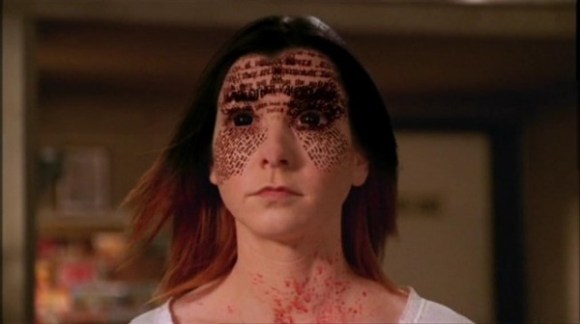
Dark Willow would find the bastards to attacked two trans* women in the subway, beating them and stripping them, along with all the people who watched and did nothing (and cheered), and recreate the scene exactly for them, because it’s horrifying enough on its own.
Dark Willow would start a reverse Spanish inquisition, complete with terrified members of the Catholic church and sadistic lesbian satanists.
Dark Willow would drown asshole Texas judges in a sea of placenta and birth certificates.
Dark Willow would make Straight Conversion Therapy a thing.
Dark Willow would make Rick Perry addicted to all the things.
The Mary Sue has a roundup of geeky musicals, something I had never actually thought about until I started reading and realized that a lot of my favourites were included (Rocky Horror, natch).
Also also also, I wrote a thing for the Mary Sue! In it I talk to several artists who, on top of being fantastically talented webcomic artists in their own right, contributed to the new instalment of Smut Peddler, an erotic comics anthology!
And to round things off, a slice-of-life short story about the near future that makes me both super excited and super scared for connected homes and other “advancements.” [Wired]
First, let’s get the really good news out of the way: Star Wars Episode VII cast Lupita Nyongo and Gwendoline Christie, and OH MY GOD WHO WILL THEY PLAY WHAT WILL THEY DO THIS IS SO EXCITING. [Entertainment Weekly]
“The publishing industry looks a lot like these best-selling teenage dystopias: white and full of people destroying each other to survive.” So says author Daniel José Older, who tackles the risks associated with an all-white publishing industry. [Buzzfeed]
In a similar vein, novelist N.K. Jemisin was a recent a guest speaker at WisCon and has a transcript of her speech available on her blog. It’s a great piece of writing about the growing presence of people of colour in genre literature, and the setbacks and dangers they can face.
Jezebel looks at HBO, its history of being a pioneer, and where the network has gone wrong, particularly with Game of Thrones and its irresponsible use of female bodies for shock value.
Anyone who’s watched the Russel T. Davies and Steven Moffat runs of Doctor Who knows that the latter has a much worse track record when it comes to female characters (both in their number and in their prominence). This infographic, via the Daily Dot, shows very clearly exactly how much both show runners cared about having a variety of women, the amount of time those women spent speaking, and whether they talked to other women at all.
Acknowledging the difficulty of being a geek in therapy, and having to bring your therapist up to speed on the community’s issues before even starting to discuss them, the people behind Geek Feminism have put together a wiki-full of resources for therapists.
Remember that time Hayao Miyazaki created a music video for Chage and Aska? The Mary Sue does.
Right when I was growing up, I, along with all the other animal-obsessed kids in North America, got a gem of a show in PBS’s Kratts’ Creatures. On the air in 1996, and rerun to death until 2000, the show followed the Kratt brothers as they explored the world and the critters who lived in it. It was a goldmine of information for kids interested in biology, conservation, and animal behaviour, but my favourite part? Sidekick Allison Baldwin.
You’d think I’d have seen myself most in the adventuring brothers, but Allison, played by actress Shannon Duff, was the main event. She was the one who, researching facts in her treehouse command centre, provided context and warning. In fact, I can trace my love of the “computer whiz who works behind the scenes” character type directly back to Allison. She was great, and got the brothers out of more scrapes than I can count.
Quick, smart, and never sidelined despite her less physical role, Allison could do everything from dispensing wisdom to rocking the hell out of her overalls. If she invited me to hang out in her treehouse, I’d be there in a heartbeat. I’d bring snacks, and we’d spend the evening watching footage of baby turtles. Get to the sea before you get eaten, baby turtles!
Anyway, Allison was the best, and I’ll leave you with an episode all about the Tasmanian devil. Cheers:
Disney is set to release Big Hero 6, a movie based on Chris Claremont’s Marvel comics, and it looks super cool. The Nerds of Color have some background on the project, and are super excited about what could potentially be the first computer animated Disney movie with a main character of Asian descent. As am I.
Here’s a great piece on the marginalization of black comic creators that takes particular aim at the trend pieces that, full of misplaced outrage, believe these creators don’t exist at all. [Badazz Mofo]
Interested in how fairy tales went from being adult stories passed on from woman to woman to male-controlled moralizing tales for children? Here ya go. [The Toast]
If you only read one thing today, let it be this amazing piece on misogyny, entitlement, and nerds. Making connections between Elliot Rodger and video games, it’s a really important piece on the systematic dehumanization of women in nerd spaces. [The Daily Beast]
Do you like Janelle Monáe, David Bowie, and superheroes? Stupid question, I know, but go watch this video. It’s part of a Pepsi ad campaign, so if I’m sharing it anyway, you know it’s got to be good.
If you care about such things, you’re probably aware that Deadpool has been confirmed as queer by the Marvel bigwigs. He’s a fan favourite, so it’s encouraging news, and here’s a Tumblr that takes a pretty in-depth look at the character’s pansexual history, despite some unfortunate typos. [Fuck Yes Deadpool]
I’ve been getting back into Futurama in a big way (I blame Burlesgeek, their May the 4th event was MCed by a pitch-perfect Zap Brannigan) and The Toast provides a hard pill to swallow: That we are all, despite our best efforts (and Leela aspirations), a Zoidberg deep inside.
Also from the Toast, a beautiful personal narrative that deals with growing up at the intersection of race and sexuality. It wouldn’t normally fall under the purview of this blog, necessarily, but it features Scott Bakula’s Quantum Leap character as “the catalyst for my earliest sexual feelings,” so close enough!
There’s something about the women WWII Colossus computer operators of Bletchley Park that I find endlessly fascinating (for reals, you should all be watching The Bletchley Circle), so I love that the remaining code breakers reunited and took a picture. [The Guardian]
I’ve mentioned the “Not All Men” meme before, but in case you’re still wondering what this hip new phrase all the kids are saying is really about, here’s a primer. [Vox]
Nintendo released its life simulation game, Tomodachi Life, without any same-gender romance options, and Polygon, among others, was not happy about it.
Want some racebent Disney princesses? Well hereyou go. [Let There Be Doodles]
I’m clearly not done talking about the Star Wars expanded universe (RIP), and io9 rounds up the ten best and twelve worst stories from the sprawling world.
Speaking of women superheroes, the BetterSupes Tumblr illustrates little girls’ superhero costumes, and the results are infinitely more creative than what big cartoon/comic book creators come up with.
Becky Chambers combines a game review (Child of Light, specifically) with a letter to her younger self, and the result is truly touching. [The Mary Sue]
Over at Quirk Books I wrote about science fiction poetry. Because that is just how I roll.
The Mary Sue has a twopart piece on the queer history of comics, and it’s worth a look.
I’ll be the first to admit that I’m a huge sucker for trailers. I’m embarrassingly easy to manipulate when it comes to these bite-sized sneak peeks, but even so, Kisima Inñitchuña (Never Alone) stands apart. The beautifully-illustrated puzzle adventure game shares Iñupiat stories and, no joke, I started tearing up. I’m that excited to play this folklore-inspired game. (Especially since you get an arctic fox as a sidekick. I love sidekicks.)
I am pretty concerned—obviously, given the title of this blog—with the killing off of women for narrative purposes. It’s a very common trope, and one that has it’s own genre: the Dead Girl Show. The Los Angeles Review of Books has an interesting take on the subject, coming to the conclusion that shows like Twin Peaks, Veronica Mars, and True Detective both forbid the Dead Girl from having any real agency, from even being a character on her own show, and “cast girls as wild, vulnerable creatures who need to be protected from the power of their own sexualities.”
A little while ago I linked to Janelle Asselin’s critique of the Teen Titans #1 cover, an insightful look at comics’ ongoing problems with bad art (and a particular type of bad art that manifests as wonky anatomy and needless sexualization of any and all women). Shocking pretty much nobody, Asselin was severely abused for daring to have an opinion, and has since received rape threats. [The Daily Beast]
We Are Comics is a great Tumblr that collects pictures and testimonials from loving, loyal fans, in the process showing the wonderful diversity of the folks who love everything from Superman to Sandman.
There’s something about a unified canon, a set of events that happened and that everyone agrees on, that really appeals to my straight-laced side. It’s why Disney throwing away the entire Star Wars expanded universe really bothered me. (I can see why they wanted to streamline, but they also really threw the baby out with the bathwater when it comes to amazing, interesting female characters). The Mary Sue, however, makes a compelling case for not caring about canon at all, that we shouldn’t let big, profit-seeking corporations dictate which stories are privileged over others. And, you know, fair point.
Autostraddle tackles Orphan Black‘s Delphine and the trope of the bisexual femme fatale.
There’s some pretty interesting research being done on male World of Warcraft gamers who choose to play with female avatars. The study found that the men pretty drastically changed their gameplay when playing as women, but not in ways that resembled how women actually play. [Geekosystem]










 unfridged