Weekend Reading List: Female friendships and flying girls

clarissaintheskywithdiamonds


Tagged , , , , , , , , , , , , , , , , , , , , , , , , ,

BAMFiles: Ursula the Sea Witch

hotbitch

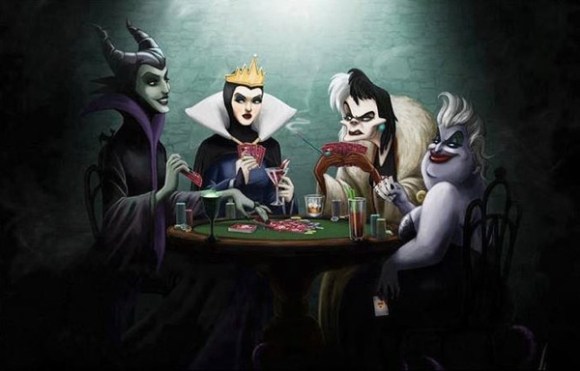
I’ve been on a bit of a Disney villain kick lately, and I can’t say that I love any of them more than Ursula (though Maleficent is a close second, girl’s got style).

I think it says something about the limited scope of Disney princesses that as I’ve gotten older, I’ve identified more with each dainty little protagonist’s equivalent villainess. And nowhere is that more true than in The Little Mermaid, also known as The Little Whiny Brat who Undergoes Extensive Plastic Surgery for the Sole Purpose of Meeting a Dude.

Honestly? Ursula’s not a bad role model:

Get kicked out of Atlantis? Set up your own lair.

Need to make a living? Prey on people’s insecurities using your powerful magic. (Hey, I never said she wasn’t evil).

Need henchmen? Get Flotsam and Jetsam, possibly the only two evil sidekicks to ever succeed at anything.

Your plan to scam the spoiled little princess needs a boost? Transform yourself into an evil version of her to seduce her one true love. (But not for long, you’re much too fabulous in your original form, hunty).

Have a body type that almost never gets any representation in Disney films (or anywhere)? OWN IT.

Ursula gets. it. done.

And I love her for it.

canIhelpthatImsofabulous

Top image by krhart.

Tagged , , , ,

Weekend Reading List: Mean Unicorns and Marvel News

jerkunicorn


Tagged , , , , , , , , , , , , , , , , , , , , , , , , , , , , ,

Rubber Spine Syndrome: A message on RSS prevention

Eschergirls1

I just spent a little while trawling Escher Girls—which is never a great idea unless I’m trying to whip myself into a Righteous Feminist Fury™—and I’m writing this out of genuine worry for the video game/comic book/anime women who seem to be missing a major chunk of their skeleton. I don’t know if you’ve noticed, but there are a significant number of women walking around without a spine.

Now this is clearly an oversight of epidemic proportions, so here’s my public service announcement:

GIVE YOUR CHARACTERS SPINES.

THEY NEED SPINES.

REALLY, THEY DO.

eschergirls2

Call it what you want—Escher Girls, The Brokeback, Rubber Spine, the list goes on—but it’s totally disconcerting that so many artists, working in so many genres, are willing to break any and all rules of proportion and perspective in a ham-fisted attempt at getting both breasts and butts in the shot. Some of these illustrations (and presented below is a tiny random sample) defy everything we know about anatomy, gravity, and bone density.

Now, I would never try to infringe on anyone’s artistic vision, but if you find yourself incapable of drawing women realistically and in ways that don’t reduce them to an awkwardly-assembled collection of sexy parts, I reserve the right to call you out on it. It’s bad art, and I expect better.

eschergirls3

I expect Black Widow to know how to take off her shoes properly (in this context “properly” means “in a way that doesn’t give me sympathy hip pain”).

eschergirls4

I expect X23 to actually be X23 and not, say, Elastigirl.

eschergirls5

I expect racist caricatures with missing left feet not to be running around New York City, posing for invisible cameras. (Seriously, what even is this.)

eschergirls6

I expect this illustration to be some sort of terrifying, Exorcist-type rotating torso, not a sexy pinup.

eschergirls7

I expect a warrior who presumably battles dragons to have a better way of dealing with hemorrhoids.

These are understandably not genres that hew too closely to realism, but the ways in which the fantasy manifests is deeply misogynistic. There’s no reason for any of these women to be contorted like this. Many of these characters (though I’m admittedly not familiar with all of them) are really fantastic, and deserve better than to be twisted and moulded into grotesque approximations of some arbitrary “sexy” template.

They’re heroes, and it’s not fair to render them literally spineless.

All images from Escher Girls.

Tagged , , , , , , , , ,

Weekend Reading List: Costumes, Classics, Queerbaiting

evilflush

Top image: “Evil Flush,” by Jesús Alfonso Sánchez

Tagged , , , , , , , , , , , , , , , , , , , , , , , , , , , , , ,

BAMFiles: Emily the Corpse Bride

EmilytheStrange

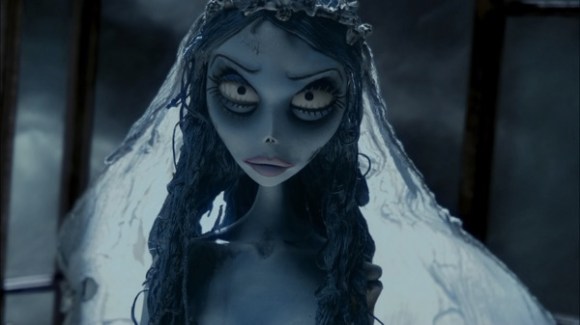
Welcome to a very special Hallowe’en edition of the BAMFiles! And who better to represent both the strength of a true BAMF and the necessary holiday-levels of spookiness than Emily, Tim Burton’s titular Corpse Bride.

Emily’s story begins in a very conventional way: She falls in love with someone whom her parents don’t approve of, plans to elope with him, and, cruelly, ends up murdered and robbed by her fiancé. Pretty standard murder victim stuff but, in a wonderful subversion of the trope, Emily’s story doesn’t end with her death.

At first, Emily sees a wedding as her salvation. Jilted in the worst way, she wants her (albeit accidental) marriage to Victor to make up for her lost happiness. In an effort to safeguard that future, she even contemplates killing Victor so that they can be together forever. She ultimately reconsiders when she realizes how selfish it would be to rob him of his chance for life and love. In the end, it’s confronting her murderer that liberates Emily. Rescuing Victor, she faces the man who took her life and shows him that he no longer has any power over her.

DIDISTUTTER

You do not mess with Emily.

She’s stronger than she was in life and, by taking her story into her own hands, she’s able to make sure justice is served, and find peace. In the face of pain and betrayal, she stays kind and joyful, and definitely deserves her place in this list.

Tagged , , , ,

Weekend Reading List: Filmography and Faerie Queen Costumes

FaerieQueen

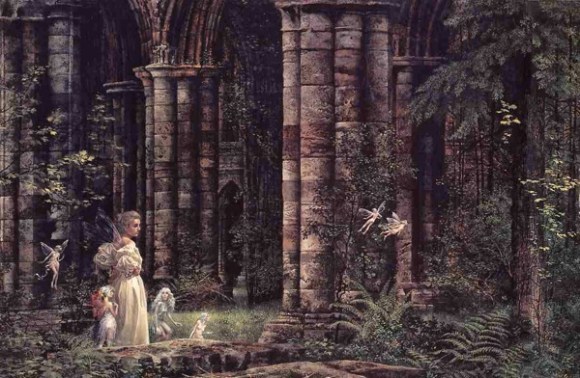
Top image: “Queen Mab and the Ruins,” James C. Christensen.

Tagged , , , , , , , , , , , , , , , , , , , , , , ,

The portal to my heart

CHELL

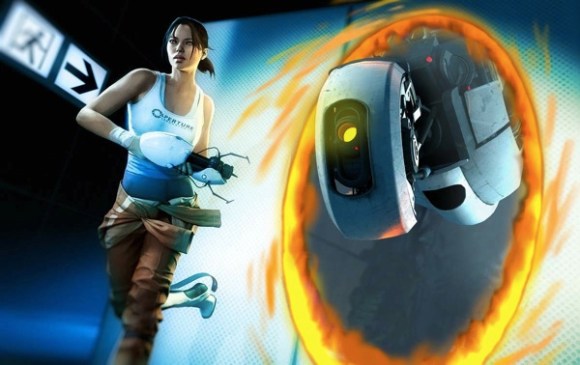
I’m almost ashamed to admit it, but I haven’t yet finished Portal 2. (Why yes, I am aware of its release date). In fact, I only managed to get to the end of the original Portal five years after it came out. But despite my chronic tardiness when it comes to video games, the franchise rapidly became one of my all time favourites. And so, in honour of my joining the ranks of those who play games on time like normal people, I’d like to revisit one of the most powerful moments I’ve ever experienced in game: The time I realized the disembodied hand holding my Portal gun belonged to a woman.

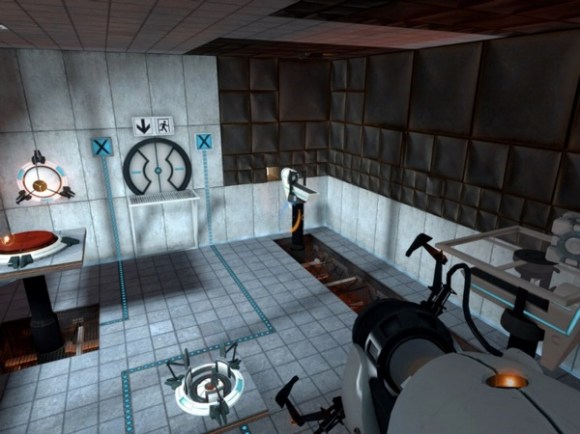
For those unfamiliar with the Portal franchise, the premise is simple. You play as a silent, orange jumpsuit-clad figure who, when furnished with a gun that creates portals in walls, must act as a lab rat, going through testing facilities and solving puzzles as if it were a labyrinth with a hunk of cheese at the end (except the cheese is cake and the cake is a lie) (play the game, you’ll get it). You can create two types of portals, an entrance and an exit, and these allow you to reach high platforms, evade obstacles (fun things like acid rivers and killer robots), and slingshot yourself across far distances, all in an effort to open the next door.

You know nothing about yourself, your backstory is unimportant. All that matters is surviving long enough to get to the next test. Your only contact with the outside world is GladOS, a chilling voice that alternately encourages you and informs you that you will never succeed. Who you are is the least of your worries. So when I happened to catch sight of myself through a conveniently placed portal, I was shocked to find out that I was actually a woman.

I was shocked because I didn’t need to be a woman. There was nothing in the story that necessitated that. I wasn’t the girlfriend of some rugged hero. I didn’t have to save my children. I wasn’t a well-known character from an already established franchise or the female equivalent of a famous male character. I just had a gun and solved puzzles.

POV

This is basically all you see of yourself.

Video games tend to treat white, straight, cisgendered men as the default human being, a template that has mass appeal. If something happens to this benchmark human, everyone can identify with it, the story can reach more people. Conventional wisdom would have us believe that the more you add on to your default—be it race, gender, queerness—the more specific the experience, and the less universal your story. Though video games are not the only medium in which this happens, it’s insulting to think that white people could not possible identify with a protagonist of colour, that men could not identify with a woman, that any variation from the status quo makes the story less capable of speaking a capital-T truth. And this belief has real-world consequences. Despite the fact that women make up a huge percentage of video game players and purchasers, we’re still struggling to have any substantial representation in the genre. It’s telling that when I only saw a gun, it didn’t even cross my mind that the hand holding it could belong to anyone but a big, chiseled man.

When I saw the protagonist (whose name is Chell, though that information isn’t made available in the game itself), I felt real joy. It meant something so profound that this person, this person so like me, could be worthy of having her story told. I paused the game for a few full seconds, processing how deeply this realization had affected me. It may seem like a strong reaction, but the effect of never seeing yourself reflected back at you is feeling like you don’t belong, like you’re not deserving. In this one game, I was getting a different message.

I already liked Portal. The puzzles were challenging and got incrementally harder in such a way that I felt like I was improving at a good pace. The tone reminded me of Vincenzo Natali’s Cube trilogy (which I highly recommend if dark, independent, Canadian science fiction is at all something that might interest you). The controls, after an initial learning curve, were easy to use and very smooth. Portal (not to mention its sequel) is a very good game. The franchise has been remarkably successful, and has managed to do so without sexualizing its protagonist (apart from a few ill-advised fat jokes, courtesy of GladOS in Portal 2). In one fell swoop, Portal has shown that yes, we can have our cake and eat it too.

Quintus-Cassius-chell-glados-valve-portal-fan-art-aperture-lab-laboratories-cube

“Aperture lab,” by QuintusCassius.

Tagged , , , ,

Weekend Reading List: Witches and women in tech

lovelacesm

  • Happy belated Ada Lovelace Day! Over at Maisonneuve, my friend Shannon Palus reflects on the first programmer in her life, her mother.
  • Women in Tech has been a bit of a hot button issue these past few weeks (and, well, months really) and an aspect of the debate that I find completely fascinating is how women already working in tech, particularly powerfully-placed women, respond to criticisms of their industry. “‘Fuck You, I Got Mine’: Women in Tech for the Patriarchy” is a really good, almost manifesto-like starting off point to understanding how women apologists are complicit in the rampant discrimination of the tech industry. [Medium]
  • Along the same lines, Amanda Marcotte creates a template for every woman-penned defence of misogyny ever written, based on that terrible, terrible Sarah Lacy article, and it is flawless. [Slate]
  • Medium also has a list of things to say to people who really liked that terrible, terrible Sarah Lacy article.
  • I’m pretty much guaranteed to love anything Becky Chambers writes, and her piece on Tor, about astronauts and science/science fiction symbiosis, is no exception.
  • Scientific American blogger Dr. Danielle Lee was treated in an incredibly unprofessional way, blogged about it, then had her response taken down without warning and without a clear reason. Here’s a breakdown of the whole situation. #standingwithdnlee [Jezebel]
  • Around this time last year, I wrote an article about creepshots and screen caps and their role in internet misogyny (it’s unfortunately not online, but you can read an excerpt if you’re interested). After weeks of research, I thought I’d seen the worst of it, but Jezebel’s outline of the Chan girl phenomenon, and its long-lasting effects on one girl who participated, has rekindled all the sadness that I remember feeling.
  • io9 explores the worst mystical pregnancies in science fiction and fantasy, and once you see all these examples listed one after another, you start realizing how pervasive and ridiculous the trope is. Don’t know what the mystical pregnancy is? No worries, there’s a Feminist Frequency video at the end that explains it all.
  • New York Comic Con had a Women of Marvel panel, and it sounds like the Q&A was pretty great. [Bleeding Cool]
  • Star Trek might be coming back to television! MAKE IT SO! And the BBC is making a miniseries based on Susanna Clarke’s Jonathan Strange & Mr. Norrell! All the exciting TV news! [The Mary Sue]
  • Would you like a totally queer, incredibly in-depth love horoscope? Of course you would. [Autostraddle]
  • Halloween is just around the bend, and what better way to get excited than by reading all about historical women who were accused of being witches (or did similarly badass things)? History Witch is on it.
  • Oh, and if you want more Bee and PuppyCat episodes, there’s a Kickstarter for that.
  • What if there’s a good reason those horrible Wartune ads say “male gamers only”? [The Toast]

Top image from Kate Beaton’s amazing Hark! A Vagrant.

Tagged , , , , , , , , , , , , , , , , , , , , , , , , , , , , , , , , , , , , , ,

Queering the Star Trek Universe

GayStarfleetAlliance

In 1966, a television show named Star Trek was first aired. The show, which followed the adventures of Captain Kirk and his crew aboard the starship Enterprise, was set in a utopian 23rd Century, a time when disease and poverty had been conquered, hunger was eradicated, and currency was useless. A time when humanity had done away with racism and sexism, and worked only to explore the galaxy and better itself.

Created by Gene Roddenberry, the original series (though problematic by today’s standards) was groundbreaking in its inclusion of both women and actors of colour who occupied highly placed and highly visible positions aboard the Enterprise. This diversity made the show much more than just another flashy, over-the-top space opera, and was directly responsible for the show’s success, a success that brought about four more television series, and a plethora of movies, novels, video games, and comics.

Star Trek was always unabashedly hopeful. By the time the first three sequels—Next GenerationVoyager, and Deep Space 9—take place, Earth has already spent 200 years without poverty and starvation. The shows represented the idea that whatever was thrown at humanity, we would triumph and persevere. It’s a theme that seems almost embarrassingly earnest given the darker, more dystopian tone of contemporary science fiction, but it’s a message that struck a chord with the original audience, and continues to do so enough to merit revisiting the world again and again. Roddenberry, in a 1973 speech, says it himself: “The whole show was an attempt to say that humanity will reach maturity and wisdom on the day that it begins not just to tolerate, but to take a special delight in differences in ideas and differences in life forms.”

But it’s because of Star Trek’s commitment to progress that one glaring omission stands out: there has never been a queer character in any of the shows. According to Star Trek lore, as a species, we have undergone a third world war, human genetic modification run amok, and a nuclear holocaust, and we’ve come out stronger for it. Are we really then still so heteronormative? In this hard-earned utopia, is there really no room for anything but straightness?

Two generations and not a whole lot of progress

Though it would have been almost unheard of to include visible queerness in the 1960s Original Series, according to George Takei (who played Lieutenant Hikaru Sulu and has since become a staunch queer rights activist), Roddenberry did want to address the issue. He didn’t, ostensibly because of the show’s precarious, about-to-be-canceled position. But in 1987, right before the beginning of The Next Generation, Roddenberry said at a convention that “we should probably have a gay character.” The first four seasons went by, however, without much of anything. Ship doctor Beverly Crusher rejected a lover once his consciousness had been transferred to a female body (in season four’s “The Host”), and that was basically it.

toogoodforyou

Your loss, Beverly.

There was a lovely little season three moment where Whoopi Goldberg changed one of her lines from “when a man and woman love each other” to “when two people love each other,” but when Goldberg also tried to get a queer couple sitting together in the background, the production team intervened.

Roddenberry remade his promise in 1991, telling The Advocate that season five of TNG would bring a gay character. He unfortunately died before the start of that season, and instead of a recurring queer cast member, we got the episode “The Outcast,” in which Riker falls in love with Soren, a member of the androgynous J’naii, who, despite the stigmas of her culture, identifies as a woman. Since the J’naii are all played by women, the effect is such that it seems like adorable, feminine Soren is being victimized by a group of dangerous, man-hating butch women. Not exactly the inclusive message that was intended to pacify an audience clamouring for more diversity (an audience that in the end resented the use of metaphor that cloaked their reality). It bears mentioning that Jonathan Frakes, who played Riker, thought the episode was too safe and tried to get a man cast as Soren, but was ultimately shot down.

ughughugh

“Our hetero love cannot be!”

Many fans blame Roddenberry’s heir Rick Berman, and it’s true that under his watch, the series never featured any explicitly queer characters, even while contemporaries like Will & Grace were making huge steps in terms of representation. TNG could have been at the forefront, had a proposed episode called “Blood and Fire” been made. The episode contained a pretty stark metaphor for AIDS paranoia—in the form of the incurable Regulan blood worms—and a veiled, passing reference to two crewmen having been together since the academy. But even that small nod was too much, and “Blood and Fire” now only exists as a fan-made film.

The subtext that never became text

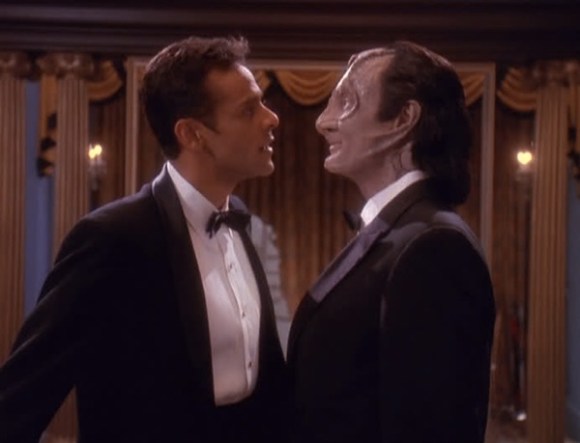
Over on Deep Space Nine, the track record for queer representation was a little better. A Cardassian character named Elim Garak was introduced early on and, well, I’ll let actor Andrew Robinson explain what happened:

“I started out playing Garak as someone who doesn’t have a defined sexuality. He’s not gay, he’s not straight, it’s a non-issue for him. Basically his sexuality is inclusive. But—it’s Star Trek and there were a couple of things working against that. One is that Americans really are very nervous about sexual ambiguity. Also, this is a family show, they have to keep it on the ‘straight and narrow,’ so then I backed off from it. Originally, in that very first episode, I loved the man’s absolute fearlessness about presenting himself to an attractive human being. The fact that the attractive human being is a man (Bashir) doesn’t make any difference to him, but that was a little too sophisticated I think. For the most part, the writers supported the character beautifully, but in that area they just made a choice they didn’t want to go there, and if they don’t want to go there I can’t, because the writing doesn’t support it.”

Nothing ended up happening between Garak and doctor Julian Bashir, though that certainly didn’t stop the audience from wanting it to.
ughsocute

I DIE.

The next almost-moment came in 1995, with the DS9 episode “Rejoined.” The introduction of the Trill species represented a turning point, and Lieutenant Commander Jadzia Dax in particular had a view of gender and sexuality that was more fluid, and obliquely queer, than most other characters. Jadzia was joined with the Dax symbiont, a slug-like life form that, when combined with a Trill host, created a whole new individual who nevertheless was in possession of the memories of each previous host. Because of this, Jadzia remembered living as both a man and woman. In the episode, it is heavily discouraged that a current host for the symbiont have anything to do with the significant others of past hosts, but Jadzia meets Lenara Khan, another joined Trill who remembers Dax as her husband. The two are drawn to one another, and even share a kiss, but in the end choose to give in to the expectations of their people, and never see each other again. Jadzia goes back to dating men exclusively.

eeeeeeeeeeeeeeeeeeeeeeeeee

Why anyone thought this should only be a one time thing is beyond me.

“But wait a minute,” you might be thinking. “There were a lot more instances of queerness in Deep Space Nine.” And that is true. When a Ferengi woman disguised as a man admits to having feelings for bar owner Quark, Jadzia takes it in stride before knowing about her true identity (“Profit and Lace”). Constable Odo, as a shapeshifter or “changeling,” is only superficially male, though there is never any exploring of gender, and his only relationship is with a woman.

“But no,” I can hear you saying. “There was that whole mirror universe. Everyone was queer there.” And here’s where things get tricky. In the Star Trek world, there is a mirror universe where everyone is evil and historical events have happened in radically different ways (yes, it’s basically as lame as it sounds). First introduced in the Original Series, the universe is revisited in four separate DS9 episodes. The evil versions of two characters, Kira Nerys and Ezri Dax, show a marked interest in women, but it’s precisely because they’re the evil bisexual versions of two good and straight characters that I don’t count them as particularly positive examples of queer representation. They both feed directly into the sly, untrustworthy bisexual stereotype (a trope from which even ex-spy/potential war criminal Garak isn’t exempt).

None of the characters who ever express queer desire are human, and despite the indirect little mentions that peppered the different series, none of the television shows ever had a long-standing character that was textually anything less than one hundred percent heterosexual.

Boldly going forward

So what happens now? Well it isn’t too late to inject the Star Trek universe with some much-needed diversity, and this isn’t exactly a new request. In 2001, shortly before Enterprise premiered, Salon published a piece that wondered whether there would finally be a queer character. Twelve years later, Wired asked the same question, this time of the upcoming film Star Trek: Into Darkness.

At least according to Enterprise showrunner (and former TNG intern) Brannon Braga, the lack of casually queer characters was a real missed opportunity, and one that he doesn’t think would be replicated today:

“There was a constant back and forth about well how do we portray the spectrum of sexuality. There were people who felt very strongly that we should be showing casually, you know, just two guys together in the background in Ten Forward. At the time the decision was made not to do that and I think those same people would make a different decision now because I think, you know, that was 1989, well yeah about 89, 90, 91. I have no doubt that those same creative players wouldn’t feel so hesitant to have, you know, have been squeamish about a decision like that.”

But still, the J. J. Abrams rebooted movies haven’t exactly delivered in this respect, despite the fact that we’re in 2013 and this shouldn’t still be an issue. There has, however, been talk of a new television series, which could provide more opportunities to repair past mistakes.

For now, any mention of queer love between Starfleet officers will have to remain in the realms of fan fiction. There you can spend a lifetime reading all the Janeway/Seven stories that have been written, and enjoy the fact that the Spock/Kirk relationship was so popular and so central to people’s understanding of the characters that Star Trek novel publisher Pocket Books felt the need to explicitly state that they were “not interested in books that suggest anything other than friendship between Kirk and Spock” in their submission guidelines. We may still be waiting, but boy are we ready.

allthefeels

All screencaps via trekcore.

Tagged , , , , , , , , , , , , , , , , , , , , , , , , , , , , , , , , , ,